

Aeronautics is a model of reliability, safety, and traceability. However, it has become a prime target for cybercriminals, not by attacking major airlines or manufacturers, but by targeting the weakest link: the supply chain.
It is no longer your safety that is at stake, but that of the entire system, as required by the new European directives.
The new scope of risk: From internal to ecosystem
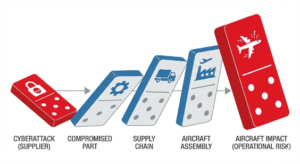
A supply chain attack occurs when a hacker exploits the vulnerability of a supplier, often smaller and less secure, to reach the end customer (the aircraft manufacturer or operator).
Why is the aviation sector so vulnerable to this domino effect?
- Privileged access: Suppliers have privileged access to customers’ information systems (plan exchange platforms, maintenance software, critical parts databases).
- Regulation: New requirements from the EASA (European Aviation Safety Agency), particularly Part IS, require operators to ensure the security of their ecosystem. Negligence on the part of a supplier can now result in penalties and suspension of operations for the end customer.
This is a legal obligation of vigilance that extends to all players in the chain.
The Threat of Lateral Intrusion
The risk is no longer limited to data theft (as with Stealer Logs). In the supply chain, it involves a lateral intrusion:
- Compromise: A subcontractor (e.g., a fleet management software publisher) is hacked via forgotten access or a simple vulnerability.
- Propagation: The hacker then uses the subcontractor’s legitimate access to inject malicious code or exfiltrate critical data from all of its customers simultaneously.
- Consequence: Production lines shut down, technical documentation modified, or a navigation system paralyzed.
CTI promoting resilience in aviation
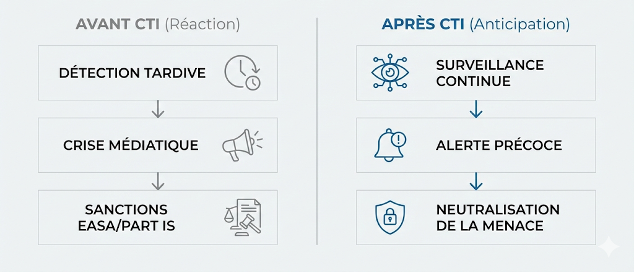
Faced with this systemic threat and compliance requirements (Part IS), Cyber Threat Intelligence is becoming an essential tool for auditing and resilience.
Phishia CTI enables you to adopt an extended monitoring strategy:
- Third-party monitoring: We don’t just check whether your credentials are on the dark web, but also those of your strategic suppliers mentioned in your documentation.
- Early Detection: Identify hacker groups (e.g., Initial Access Brokers, or IABs) that target IT systems in the aerospace and industrial sectors.
- Proactive Compliance: Provide the necessary evidence of vigilance to meet the increased regulatory requirements of EASA and Part IS.
A partnership beyond boundaries
For those in the aerospace industry, CTI is not a cost, but an investment in business continuity and regulatory compliance. Phishia gives you the visibility you need to identify and neutralize these risks before they paralyze an entire industry.
Whether you are a major contractor concerned about your Part IS compliance, or a critical supplier that must guarantee maximum security, our Classic CTI Offering provides you with continuous assurance of the integrity of your ecosystem.
