

Accueil > Steering and compliance > ISO 42001 & SMIA support
ISO 42001 & SMIA support
The ISO 42001 standard provides a framework for AI management by ensuring governance, security, transparency, and ethics, while the AI Act establishes the European legal framework. Our service helps you align your organization with both standards for smooth, sustainable, and proactive compliance with regulatory requirements.
Service Objectives
1.
Ensuring Regulatory and Normative Compliance
Guiding you in aligning your AI systems with the requirements of the AI Act and ISO 42001 certification.
2.
Optimizing AI Management
Develop and implement AI management practices that comply with international standards.
3.
Promote Transparency and Ethics
Ensure that your AI practices comply with ethical and transparency principles.
ISO 42001
3 objectives
Comply with current and future regulations (IA ACT)
Meet stakeholder requirements
Develop responsible solutions
IA Act
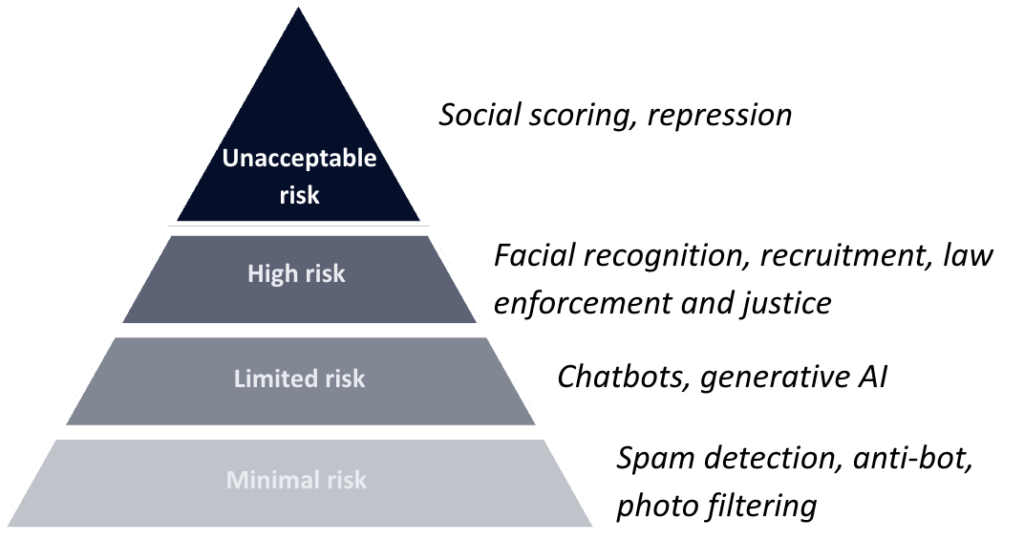
The European AI Regulation (AI ACT) aims to regulate the development, marketing, and use of artificial intelligence systems with a focus on risks to health, safety, and fundamental rights. Penalties for non-compliance are 7% of turnover (up to a limit of €35 million). The AI ACT is based on a risk-based approach:
IA ACT vs ISO 42001
| Criteria | AI Act | ISO 42001 |
|---|---|---|
| Nature | Mandatory legal regulation | Voluntary standard for certification |
| Scope | European jurisdiction | International application |
| Requirements | Focused on compliance and sanctions | Focused on governance and continuous improvement |
| Auditability | External regulatory audit | Internal audit and external certification |
Similarities
Ethical principles
Transparency, non-discrimination, security, and reliability of AI systems.
Risk management
Identification and mitigation of risks related to algorithmic bias, functional drift, and data security.
Documentation and traceability
Common requirement for transparency in the development and deployment of AI systems.
Steps in the ISO 42001 certification process
- model lifecycle,
- documentation analysis,
- data security, governance,
- AI strategy
- Governance: formal policy, roles (AI Manager, committee), ethical & regulatory commitments.
- Operational: documented model lifecycle, transparency/explainability, regular internal controls.
- Security & performance: GDPR/27001 alignment (encryption, anonymization, etc.), monitoring indicators, periodic reviews.
- Pre-audit: organizing the audit, collecting and transferring documents.
- D-day: managing discussions and providing support during interviews.
- Post-audit: action plan, updating evidence, and following up on corrections.
Why choose us?
Specialized Expertise
Our team has in-depth expertise in AI management and regulatory compliance, ensuring effective integration of the required practices.
Personalized Approach
We tailor our support to the specific needs of your organization, taking into account your processes and environment.
Rigorous Management
Rigorous implementation of the standard’s requirements to ensure sustainable compliance.
Comprehensive Support
Assistance at every stage of the process, from initial audit to implementation and ongoing monitoring.
Our articles
Discover the latest news and trends in governance and compliance.
